
PURDUE IN FINAL FOUR?

Don’t believe everything AI tells you. (Photo credit: The Weekly Opine / NCAA)
So said AI
As many readers of The Weekly Opine know, I am not a fan of artificial intelligence. For sure, there are viable applications whereby AI has merit. But the downside of AI far outweighs the upside. This is not even a point of contention. The damage AI has already done, and the damage AI will do, is incomparable. When viewed next to one another, “bad” AI stands like Dubai’s Burj Khalifa skyscraper. Comparatively, “good” AI is like the Washington Monument… dwarfed by AI’s dark side.
Last Saturday, I experienced a comical, yet troubling example of how AI is too often jacked up, capable of delivering grossly inaccurate information.
AI forgot to tell Arizona
Saturday night I watched the Elite Eight contest between Arizona and Purdue. It was a tight game during the first half, with Purdue surging to a 38-31 halftime lead. With about 12 minutes left in the game, I wondered where Arizona coach Tommy Lloyd coached prior to becoming the Wildcats head man. So, I grabbed my iPhone. What happened next was mind-blowing.
I went on the popular go-to source, Google, and typed in “Tommy Lloyd.” After Tommy Lloyd information appeared, I clicked “What’s New.” Then Google’s AI Overview took over. As you’ve probably experienced, AI Overview supersedes traditional Google at the top of the screen. On this occasion AI presented information that was unbelievable. It was a jaw-dropping, surreal moment. My “what the…?” reaction was apocalyptic. Below is the screenshot I encountered.
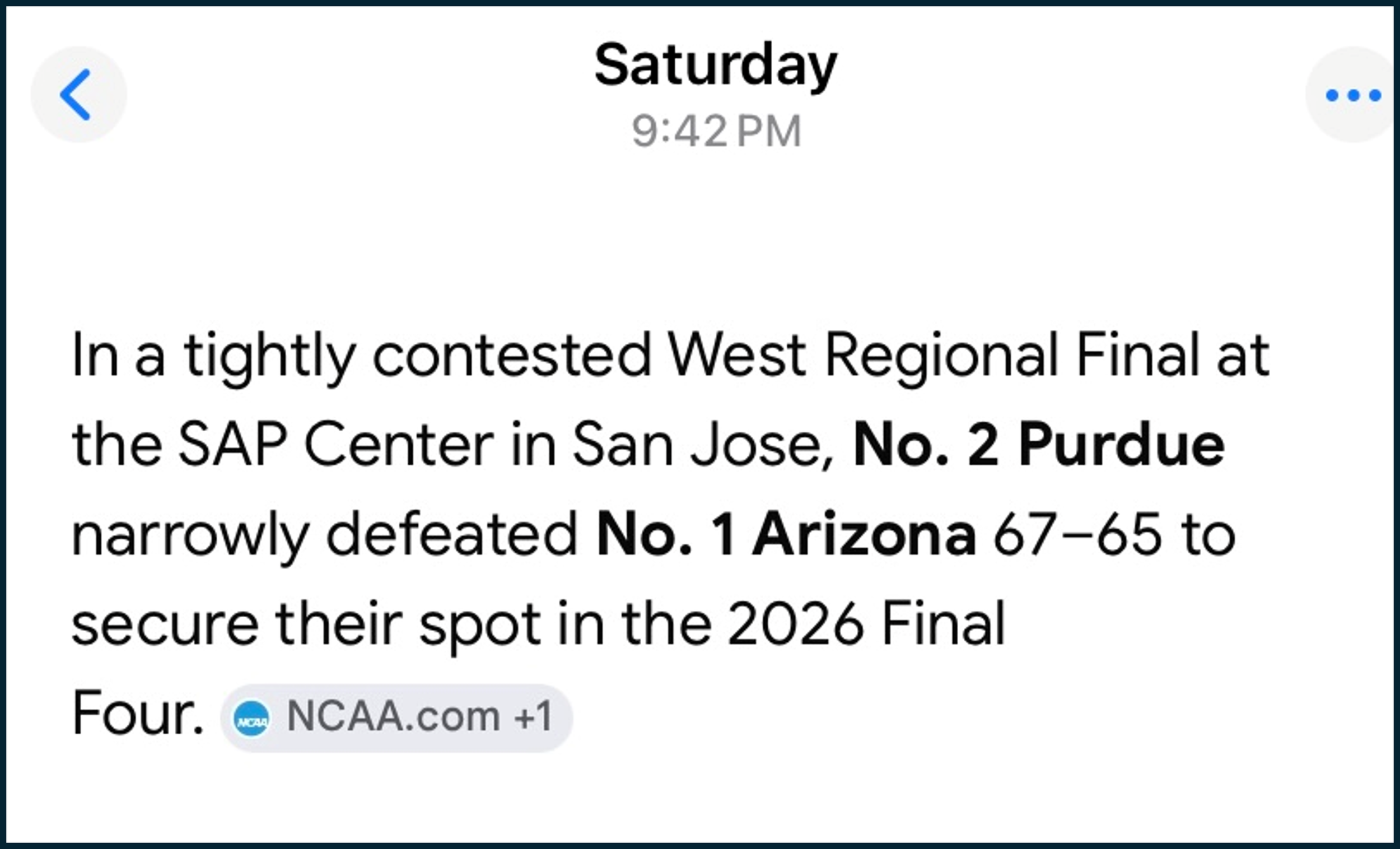
Astonishingly, in a game with 12 minutes remaining in the second half, AI confidently proclaimed Purdue beat Arizona 67-65 to advance to the Final Four! It was dumbfounding. At first, I thought AI was talking about a game Purdue and Arizona might have played two years ago when Purdue advanced to the Final Four. Befuddled, I continued reading AI’s highlights. Based on AI’s game summary, a portion of which is below, there was no doubt AI was describing the game I was watching at that moment. And AI was telling me the game was over and Purdue was Final Four bound.

Besides the sheer absurdity of AI’s conclusion, I wondered, what if someone saw this and believed AI knew who won the game and the TNT broadcast was on a time delay? What if, based on AI’s (false) reporting, someone believed they just lucked into inside information and placed a huge prop bet that Purdue would win the game? (As you may know, Arizona beat Purdue, 79-64.)
And how did AI come up with such an outlandishly wrong outcome? Just a guess here but possibly AI made calculations based on all of Purdue’s and Arizona’s games this season, how they performed after halftime and so on. And then, with supreme assuredness, AI said Purdue won the game, 67-65. AI’s gig was up when Arizona scored their 65th point with around seven minutes still to play in the second half. Hoops fans know Arizona is too talented to go scoreless during the final seven minutes.
Saturday’s faux pas was tame
A primary concern regarding the growing – and apparently unstoppable – spread of AI is human job loss. (Other grave concerns include overuse of resources, e.g., data centers require enormous amounts of water and electricity; unrelenting noise from turbines; and humans who live near data centers getting sick from toxins.)
The International Monetary Fund (IMF) forecasts four out of ten jobs will be affected by AI. One example; Amazon has made sizeable workforce reductions in favor of more investment in AI development. Amazon head Andy Jassy said last year that “fewer people [will be] doing some of the jobs being done today.” Software manufacturer Oracle just announced thousands of job cuts, too. Why? To invest in AI data center infrastructure.
Google, Meta, and Pinterest plan to lay off workers because AI enables them to do more with less. “I think 2026 [will] be the year that AI dramatically changes the way we work,” Meta founder Mark Zuckerberg said in January.
Here are some of the tech elites ruining society. (Photos credit: top left clockwise: Meta, Google, OpenAI, Yahoo Finance)
Anthropic CEO Dario Amodei says AI could increase unemployment to 20% within five years (or less). Amodei focuses on AI safety and believes in “principled restraint” whereby AI values safety over speed of development. Amodei sees AI causing consequential disturbance, negatively impacting “entry-level, white-collar jobs.” Currently, unemployment in manufacturing and white-collar service jobs is rising because of AI.
“Raise college prices for decades then have AI replace white-collar jobs,” said Andrew Lokenauth of The Finance Newsletter. “Make the college degrees they went into debt for completely useless.” In other words, the highly educated may become disempowered.
Palantir is a data analytics and AI software firm. Speaking on CNBC this month the company’s CEO, Alex Karp, says Palantir’s AI will shift power away from “mostly Democrat, highly educated, humanities-trained, often female voters.” Who benefits? According to Karp, “vocationally trained, working-class, mostly male voters” will gain as society becomes less educated. No thanks.
The Washington Post reports Elon Musk and other tech elites are creating humanoid robots to eliminate human labor. OpenAI CEO Sam Altman, on record saying AI could make humans extinct, appears OK with that outcome, i.e. humans and machines merging, with humans subservient. Altman, like some other tech industry billionaires, seems to lack empathy for humans. The term “longtermist” describes a philosophy where some humans are expendable and – if need be – should be sacrificed so that other humans can live long into the future, evolving as machines instead of flesh and blood people. Bizarre.
When I woke up Sunday morning, all the major TV networks and ESPN’s app confirmed it: Arizona is headed to the Final Four, not Purdue.
Oh, I forgot to mention that before he became Arizona’s head coach in 2021, Tommy Lloyd was a long-time assistant at perennial West Coast powerhouse Gonzaga.
© 2026 Douglas Freeland / The Weekly Opine. All rights reserved.