
MAY MADNESS
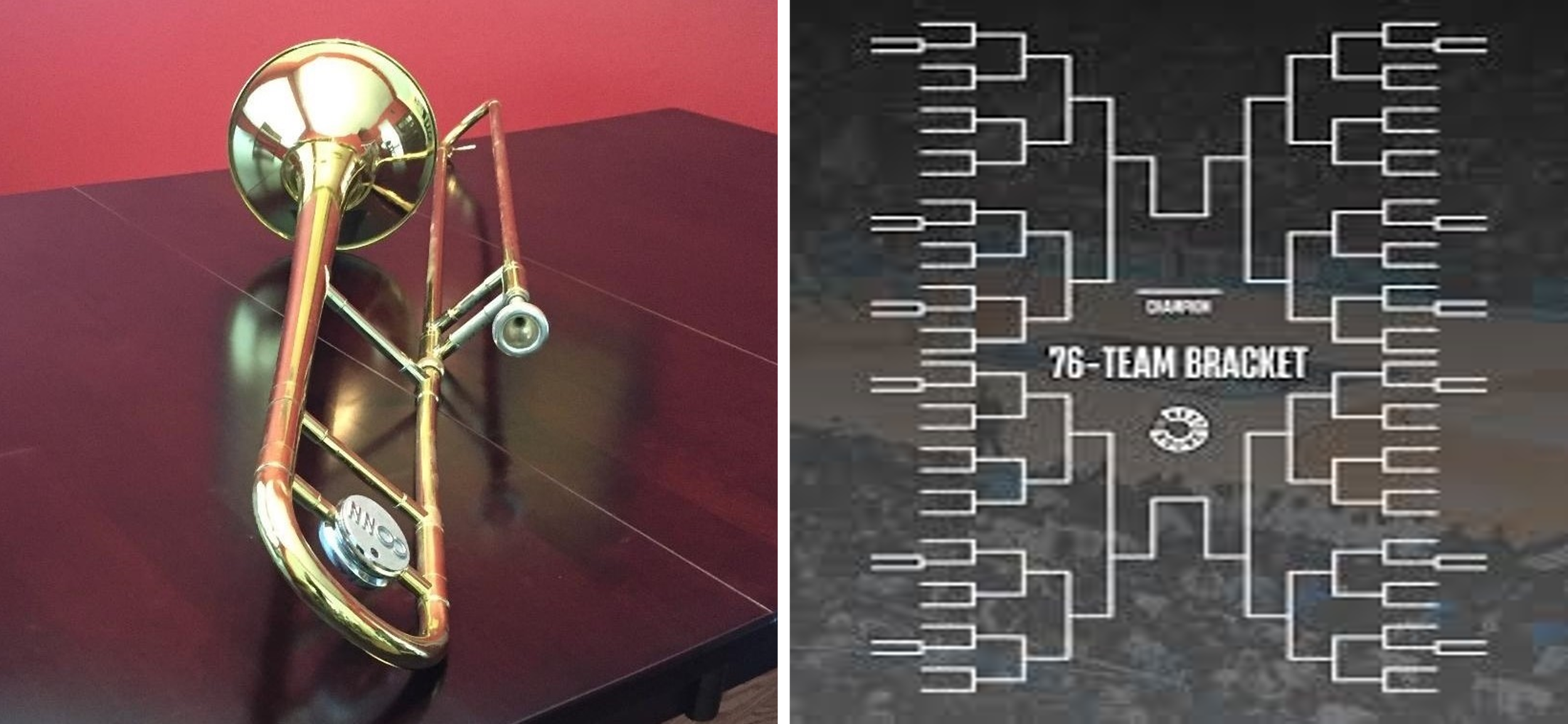
Seventy-six trombones sounds marvelous. A 76-team NCAA bracket feels cheap. (Photos credit: The Weekly Opine / Facebook)
NCAA drifts off course… again
Goodness gracious, NCAA leadership are at it again. Every few years the honchos at the NCAA opt to hone their idiocy skills by making suboptimal, greed-fueled decisions. Seventy-six teams in the NCAA tournament? Nothing like creating a watered-down version of what is the greatest sports month on the calendar. It was bad enough when the tournament added unnecessary play-in games in 2011, growing the field from 64 to 68 teams.
Last week’s announcement, that adds eight teams to both the men’s and women’s tournaments, smacks of a brain cramp from an organization that seems happiest when wallowing in muck of their own making.
Going way back in the day, the field consisted of 32 teams. In 1976, Indiana captured the national championship, doing so beating five teams ranked in the Top 20 in the final regular season poll. IU opened the tournament beating #17 St. Johns and continued on to defeat #6 Alabama, #2 Marquette, #5 UCLA and #9 Michigan. No cupcakes on the menu.
A 76-team Big Dance will spark images of an all-night dance marathon with too many rhythm-less couples taking up space, until they are tapped on the shoulder to exit the gymnasium.
Why include more teams that have zero chance of winning the championship? Why of course, to increase media rights fees and fuel America’s insatiable compulsion for sports betting. And although the NCAA does not get a cut of gambling fees, some state governments funnel tax revenue from betting to university athletic departments.
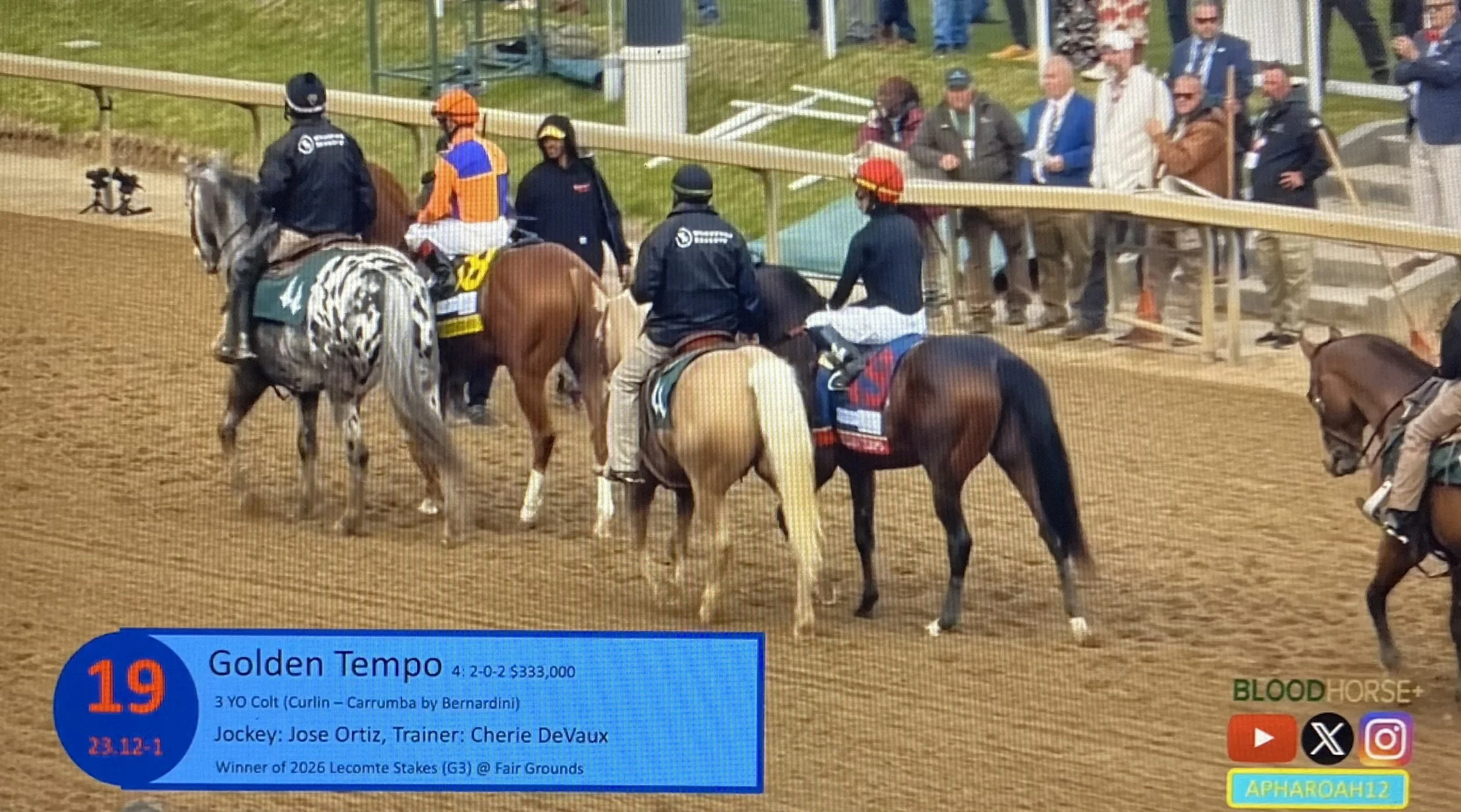
Would you want to see guide horses racing with thoroughbreds? (Photo credit: YouTube)
Only thoroughbreds need apply
Viewers of the Kentucky Derby are familiar with racehorses trotting onto the racetrack moments before the race starts. The thoroughbreds are accompanied by guide horses. Guide horse’s role is to calm the high-strung racehorses. So, who in their right mind would say, “hey, let’s increase the field size by allowing guide horses to race in the Derby against thoroughbreds?” That’s what the NCAA just did.
Adding more teams to the March Madness field – teams who will not win the tournament or even sniff the Final Four – essentially places guide horses in the tournament. It adds a layer of mediocre teams the thoroughbreds (e.g., Duke, UConn) will beat while adjusting to tournament pressure.
Not to be outdone, the College Football Playoff committee is itching to be awarded dunce caps. Expanding from 12 to 16 teams makes sense. However, the CFP and major conferences are jonesing for a 24-team playoff (which might be a precursor to a 32-team football playoff).
The lid is off
Greed caused the wrecking of professional golf with the LIV-PGA spat. Golf hasn’t been the same since. Many years ago, greed fueled the downfall of the United States Auto Club. A split created rival leagues, the Indy Racing League and Championship Auto Racing Teams. The once dominant American motorsport – open-wheel racing – never recovered, even after they came together as IndyCar. NASCAR filled the void to become America’s preeminent motorsport.
Just a few days prior to learning of March Madness expansion to 76 teams, I cancelled ESPN and FS1 from my television package. I no longer watch baseball, NBA basketball or hockey, and ESPN showing pillow fighting is beyond silly. NFL, college basketball and college football games on ESPN, FS1 (and Amazon and Peacock) will proceed without me.

College athletics is flush with money. (Photo credit: Microsoft PowerPoint)
Cash, baby!
In college hoops, the going rate for top players in the transfer portal is absurd. According to analysis by The Field of 68’s Jeff Goodman, top big men are getting $4-5 million, top point guards command $3-4 million, and top wing players haul in $2-3 million. Same thing in college football. Max Olson of @espn reports top quarterbacks are paid $3-5 million, top running backs $500,000-$750,000, and top receivers make $500,000-$750,000. Top linemen get $500,000-$1 million, top linebackers earn $300,000-$500,000 and top defensive backs get $400,000-$800,000.
This spring, ESPN reported 3,000 players were expected to enter the basketball transfer portal, a 43% increase from two years ago. A few players whose eligibility expired sued the NCAA, seeking loopholes to regain moneymaking eligibility. Understandably, the players are gettin’ while the gettin’s good. Athletes are doing what coaches have done for years… play the free market.
Why begrudge players getting paid? I believe athletes deserve a piece of the action. But the NCAA should have gotten in front of this a decade ago, as D-1 athletic revenues grew from $4 billion in 2003 to $17.5 billion in 2022. Commonsense structure would enable players to get paid without soiling the product with unsavory NIL deals, increased threat of corruption tied to gambling, and a ballooning transfer portal that resembles livestock in a pen going to the highest bidder.
Television ratings and betting on games thrive, but I don’t feel the same connection. Due to outlandish money, college sports feel sullied. In college hoops Indiana, my alma mater, brought in eight new players two years ago, 13 new players last year, and nine for the upcoming season (players or mercenaries?). I feel little passion for the team. While it was thrilling watching the Hoosiers win the football national title, I recoil hearing the amount of money needed to buy players, some of which should be used for academic scholarships, competitive salaries for faculty, etc.
In a sign of what the future portends blueblood Duke, in a strategic free market move, inked a deal with Amazon to stream three Duke basketball games next season. At what point do other schools follow suit? USA Today’s Matt Hayes surmises that college football powerhouses will lean into free market deals with streaming services for some or all home games, with or without conference (e.g., SEC, Big Ten) support.
Make it make sense
Does 76 make sense? It did in the 1957 Broadway musical The Music Man. Actor Robert Preston set the standard brilliantly singing “Seventy-Six Trombones.” But 76 teams in the NCAA tournament?
That’s madness.
© 2026 Douglas Freeland / The Weekly Opine. All rights reserved.